Baby is crying
Sound is sorted out on the phone itself, and confirmed over several seconds before it wakes you.
 Bebrise
Runs on a spare phone · video stays home
Put a spare phone by the crib and it listens and watches for you, speaking up only when something needs you. Go and shower, cook, or nap — and look in whenever you want.
Privacy
Because there is no route for it to take. The bedside phone does the listening and watching itself; when you look in, the two phones link up over your own Wi-Fi and the picture goes straight from one to the other, never leaving your home. Even if we wanted to look, there would be nothing for us to get.
Video only travels between these two
Never gets outYou'll need two phones
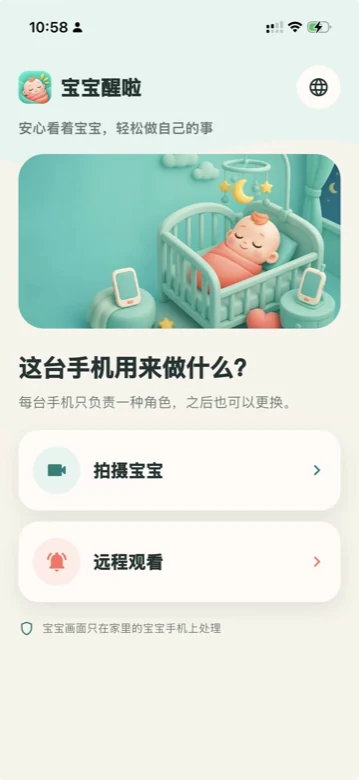
The one by the crib is what the app calls the bedside phone — an old handset from a drawer will do — an iPhone 6s or newer, or an Android phone from roughly 2016 on. Open the app on it and choose Film baby. The one you carry is the caregiver phone: same app, choose Remote viewing. One thing to be upfront about: it supports one caregiver phone at a time, so two parents can't each watch from their own phone yet.
How to get the appProp it up and circle where baby sleeps. It needs to stay plugged in, so give it somewhere with airflow.
On the same Wi-Fi the two phones find each other, or just scan a code.
It calls you when something happens, leaves you alone when nothing does, and you can look in any time.
Will it cry wolf?
A curtain moving or a noise upstairs shouldn't get you out of bed. So it watches a few seconds longer, and only then tells you — with the picture attached, so one glance says whether to get up. It can't claim it will never get things wrong, because no machine can; but it tries not to cry wolf, and it says so plainly when it can't see properly. When it does speak up, it is basically one of these three:
Sound is sorted out on the phone itself, and confirmed over several seconds before it wakes you.
It keeps an eye on the zone you circled, and tells you if baby moves out of it.
Too dark, blocked, or a frozen picture — it says so, instead of pretending everything is fine.
To be clear: Bebrise is only there to help you keep half an eye on things. It does not judge whether your baby is breathing or smothered, makes no health or medical assessment of any kind, and can never take the place of a grown-up going to look.

Getting it
Bebrise is still in small-scale home testing and isn't in the app stores yet. Pick the phone you use and we'll send you the install details.
These open your mail app; once we get it we'll send you the install details.
Common questions
Including the things we can't do yet.
No. Bebrise exists precisely so a spare phone can do the job — an iPhone 6s or newer, or an Android phone from roughly 2016 on, as long as its camera, microphone, Wi-Fi, and Bluetooth still work.
It does get noticeably warm, and it has to stay plugged in — keeping a camera running while watching and listening the whole time is hungry work. We're still testing how hot it gets and whether it holds up all night across different phones, and we can't yet give an answer that's true for every one of them. Put it somewhere with air around it, never tucked against bedding, pillows, or other fabric.
Not yet. Only one caregiver phone can be connected at a time. Letting each person in the family watch from their own phone is something we haven't built.
Not yet. The picture only travels on your home Wi-Fi, so you can't watch once you've left the house. That is exactly why it never reaches us. If we ever build it, we'll ask you plainly first, and make sure only your own phone can open the picture.
It depends which. If your broadband is down but your Wi-Fi is still on, watching and alerts carry on as normal. If the Wi-Fi is gone too — say the router lost power — you won't be able to watch; the bedside phone still keeps listening and watching, and still sounds its own alerts.
No. Bebrise makes no health judgement of any kind, and will not dress up an ordinary camera and a bit of sound recognition as something that measures breathing or heart rate. What it helps with is crying, baby leaving the picture, and the moments when a grown-up should go and look.